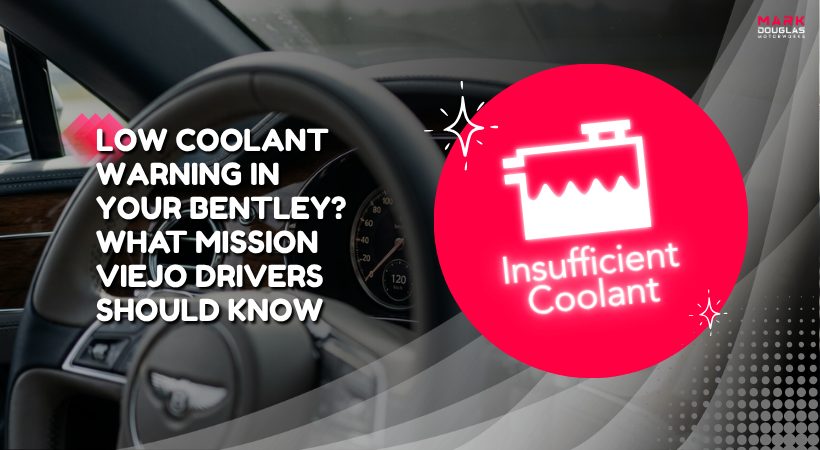
A low coolant warning in your Bentley is not something you acknowledge and drive through. On a vehicle engineered to the standard of a Continental GT, Flying Spur, or Bentayga, the cooling system maintains extraordinarily tight thermal tolerances — and when coolant level drops below the minimum threshold, the margin between a warning light and a catastrophically overheated engine is measured in minutes of sustained driving, not miles. Mission Viejo‘s warm climate and the stop-and-go nature of traffic on the 5 and 241 make that window even shorter than it would be in a cooler market.
Mark Douglas Motorworks is Mission Viejo’s #1 exotic auto repair and service specialist, serving Bentley owners across Mission Viejo, Laguna Niguel, Lake Forest, Aliso Viejo, and South Orange County from our Madero location. If you’re seeing a low coolant warning in your Bentley, here’s exactly what you need to know before you make another move.
What the Bentley Low Coolant Warning Actually Means
Bentley’s cooling system uses a pressurized closed-loop circuit that circulates coolant between the engine, radiator, heater core, and auxiliary coolers serving the transmission, differential, and charge air system, depending on the model. The system is sealed and should not lose coolant under normal operating conditions. When the level sensor in the coolant expansion tank detects a drop below the minimum mark, the warning illuminates on the instrument cluster.
This warning means one of three things: the system has a leak that’s allowing coolant to escape, the coolant has been consumed internally (a sign of head gasket compromise), or the expansion tank itself has cracked — a known failure point on certain Bentley platforms. All three scenarios require immediate diagnosis. None of them are resolved by simply topping off the reservoir and continuing to drive.
On Bentley’s W12 engines — used in the Continental GT and Flying Spur — the cooling system complexity is exceptional, with multiple coolant circuits and auxiliary pumps that must all function correctly to manage the thermal output of a 600+ horsepower engine. A low coolant condition on a W12 Bentley is never trivial.
Symptoms That Accompany a Bentley Low Coolant Warning in Mission Viejo
Mission Viejo Bentley owners who notice a low coolant warning should also watch for these accompanying symptoms that indicate the severity and nature of the underlying fault:
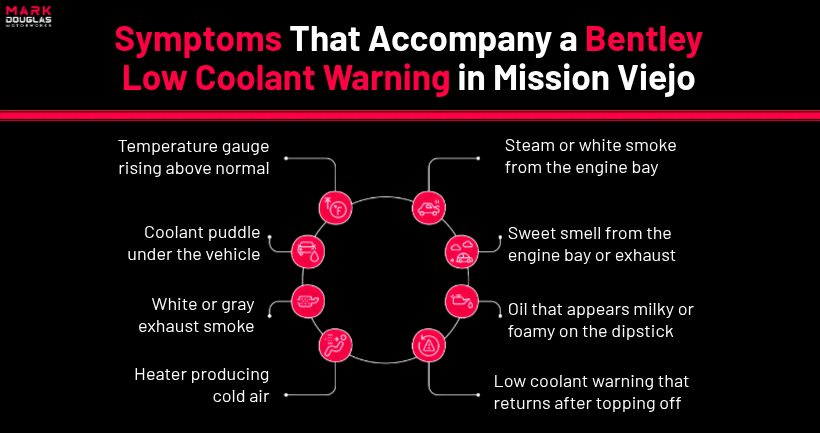
- Temperature gauge rising above normal — the most urgent accompanying symptom, indicating the engine is approaching thermal limits
- Steam or white smoke from the engine bay — coolant contacting hot engine surfaces and evaporating
- Coolant puddle under the vehicle — visible evidence of an external leak from a hose, radiator, water pump, or expansion tank
- Sweet smell from the engine bay or exhaust — burning coolant has a distinctive sweet odor that’s unmistakable once you know it
- White or gray exhaust smoke — coolant entering the combustion chamber through a compromised head gasket, burning and exiting through the exhaust
- Oil that appears milky or foamy on the dipstick — coolant mixing with engine oil, one of the most serious indicators of internal head gasket failure
- Heater producing cold air — coolant level too low to circulate through the heater core effectively
- Low coolant warning that returns after topping off — confirms an active leak rather than simple evaporation loss
What Causes Low Coolant in Bentley Vehicles in Mission Viejo
Several causes account for the majority of Bentley’s low coolant warnings we diagnose at our Mission Viejo shop:
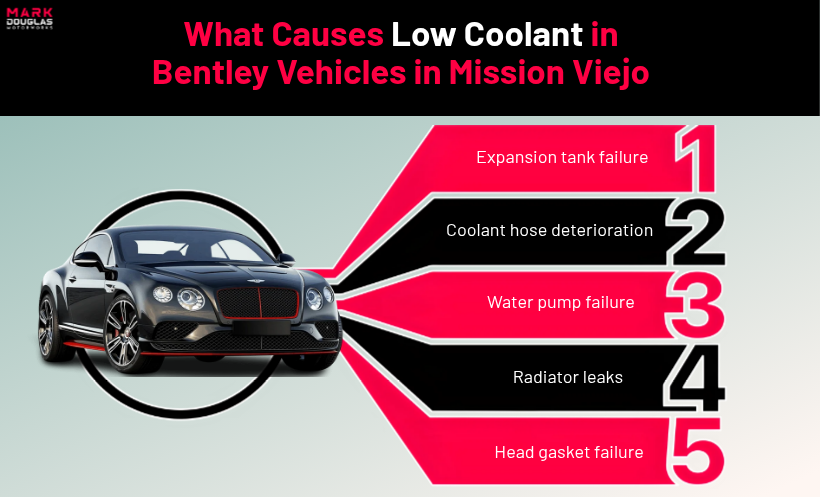
- Expansion tank failure is the most common cause of coolant loss on Bentley Continental GT and Flying Spur models. The plastic expansion tank develops cracks — typically at stress points near the filler neck or mounting brackets — that allow pressurized coolant to escape slowly or suddenly. South Orange County’s thermal cycling between cool marine mornings and warm inland afternoons repeatedly stresses these plastic components. An expansion tank that’s been heat-cycled for years develops micro-fractures that eventually propagate to visible cracks under system pressure.
- Coolant hose deterioration — Bentley’s W12 engine uses a complex network of coolant hoses that route between the engine, radiator, heater core, and auxiliary coolers. Over time, the hose rubber hardens and develops cracks at the clamp points where compression and vibration concentrate stress. A hose that’s been on a Bentley for 60,000+ miles in Mission Viejo’s climate is due for inspection regardless of appearance.
- Water pump failure — Bentley’s water pumps — both the main mechanical pump and the auxiliary electric pumps on W12 models — develop seal failures and bearing wear over time. A failing water pump seal causes a slow coolant leak near the front of the engine, often not visible until coolant has been running low for some time.
- Radiator leaks — Bentley’s aluminum and plastic radiators develop leaks at the crimp points where the plastic end tanks meet the aluminum core, particularly after stone chip impact damage or thermal fatigue. Mission Viejo’s freeway driving on the 5 and 241 exposes Bentley radiators to frequent collisions with road debris.
- Head gasket failure — while less common than external leak sources, head gasket compromise on high-mileage or previously overheated Bentley W12 engines produces internal coolant consumption that manifests as a low coolant warning without any external leak. This is the most serious scenario and requires immediate professional diagnosis.
Why Mission Viejo Bentley Owners Cannot Drive Through a Low Coolant Warning
Bentley’s W12 engine is an engineering marvel — but it is also an extraordinarily sensitive machine when it comes to thermal management. The W12’s compact architecture, high power output, and tight component tolerances mean that thermal damage from an overheating event occurs faster and at lower temperatures than on simpler engines.
An overheated Bentley W12 can sustain warped cylinder heads, failed head gaskets, damaged valve seats, and in severe cases, scored cylinder walls — all from a single sustained overheating event. In Mission Viejo’s warm climate, where ambient temperatures reduce the thermal margin the cooling system has to work with, the time from low coolant warning to critical overheating is shorter than in a cooler market.
The cost of a proper cooling system repair on a Bentley — even a major one — is a fraction of the cost of the engine work that a severe overheating event requires. Every mile driven past a low coolant warning increases the risk of the more expensive outcome exponentially.
How Mark Douglas Motorworks Diagnoses and Repairs Bentley Cooling System Issues in Mission Viejo
Our certified technicians use Bentley-compatible diagnostic equipment and factory-grade tools to perform a comprehensive cooling system evaluation — pressure testing the system to identify the leak source, scanning the engine management system for cooling-related fault codes, inspecting the expansion tank and hoses, and checking for internal coolant consumption through combustion leak testing.
Once the source is confirmed, we provide a clear, prioritized repair estimate with OEM or OEM-equivalent components. Bentley cooling system repairs are never completed with generic aftermarket parts — the thermal specifications and material requirements of Bentley’s cooling circuit demand components engineered to the same standard as the originals.
For Bentley cooling system repair in Mission Viejo performed with the world-class attention to detail that an exotic vehicle deserves, Mark Douglas Motorworks is Mission Viejo’s answer to dealership-quality service without dealership pricing or wait times.
Why Choose Mark Douglas Motorworks for Bentley Repair in Mission Viejo, CA
Mark Douglas Motorworks is  the #1 exotic auto repair and service shop near Mission Viejo, specializing exclusively in Bentley, Aston Martin, Ferrari, Maserati, and Rolls-Royce. Our technicians work on these vehicles every day — not occasionally — with the factory-grade tools, materials, and expertise that hyper-luxury vehicles require. We offer a genuine dealership alternative for Bentley service in Mission Viejo that eliminates wait times, inflated pricing, and impersonal service that dealership service often entails.
Located at 23255 Madero, B109 in Mission Viejo, we serve Bentley owners across Mission Viejo, Laguna Niguel, Lake Forest, Aliso Viejo, Rancho Santa Margarita, and South Orange County.
Frequently Asked Questions About Bentley Low Coolant Warning in Mission Viejo
Can I top off my Bentley’s coolant and keep driving?
Topping off temporarily restores the level but doesn’t address the leak. If the level drops again within a short period, the leak is active and continuing to drive risks of overheating damage. Get it pressure tested and diagnosed before driving any significant distance.
How do I tell whether my Bentley’s low coolant is due to an external leak or an internal head gasket issue?
External leaks typically show as puddles, steam, or wet residue near the engine bay. Internal consumption — head gasket — is indicated by white exhaust smoke, milky oil, or coolant reservoir bubbles. Mark Douglas Motorworks performs combustion leak testing to differentiate definitively between the two.
How much does Bentley cooling system repair cost in Mission Viejo?
Cost varies significantly by cause — expansion tank replacement is a moderate repair, while head gasket work on a W12 is a major service. Mark Douglas Motorworks provides a complete itemized estimate after diagnosis before any work is authorized. Call (949) 472-8842 for a consultation.
Does Mark Douglas Motorworks service all Bentley models?
Yes. We service the Continental GT, Flying Spur, Bentayga, and Mulsanne — covering all engine variants including the W12, V8, and V6 hybrid platforms.
Schedule Your Bentley Cooling System Inspection in Mission Viejo Today
A low coolant warning in a Bentley demands same-day attention. Mark Douglas Motorworks has the exotic vehicle expertise and factory-grade equipment to diagnose and repair it correctly — without the dealership hassle. Call (949) 472-8842 or book online at markdouglasmotorworks.com!