
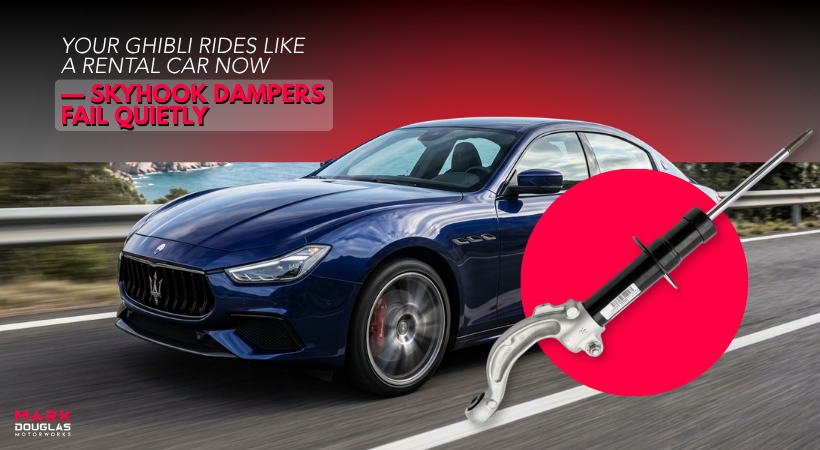
Nothing lit up on the dash. The car simply stopped being interesting. Over the expansion joints on the I-5 through Mission Viejo the body floats a beat too long, then slaps hard over a driveway apron, and pressing Sport changes the exhaust note but no longer changes the ride.
That combination is Skyhook giving up. Maserati’s adaptive damping reads the road several hundred times a second and adjusts each corner to match, so when a damper leaks or a solenoid stops answering, the car does not fail — it just gets worse. Late-season heat and canyon pavement are what bring it to the surface.
Quick Summary: Key Takeaways
- What Skyhook is: Accelerometers at the wheels and body feed a control module that varies damping at each corner through a solenoid valve inside the shock.
- How it fails: A leaking damper or a dead solenoid, usually one corner at a time, often with no warning message at all.
- The symptom is ride quality: Floaty over long undulations, harsh over sharp edges, and no felt difference between the drive modes.
- Which cars: Ghibli, Quattroporte, Levante and GranTurismo all use adaptive damping, with different valves and calibration by model.
- Replace in pairs: A fresh damper opposite a ten-year-old one gives you a car that pulls unevenly over every bump.
Skyhook adjusts each corner faster than you can feel it
Inside each damper is a solenoid valve that changes how easily oil moves between chambers. Open it and the corner goes soft; close it and the corner firms up. The control module reads accelerometers at the wheels and the body and picks a setting for each corner continuously, which is how a 4,300-pound sedan can stay flat through a corner and still ride.
Two things break that loop. The damper itself leaks, losing the oil the valve was metering, or the valve stops responding to the module. We see the first far more often.
Because the module can hold a plausible setting even when a corner is not obeying it, there is often no dash message. The car does not complain. You do.
The ride tells you before any warning light does
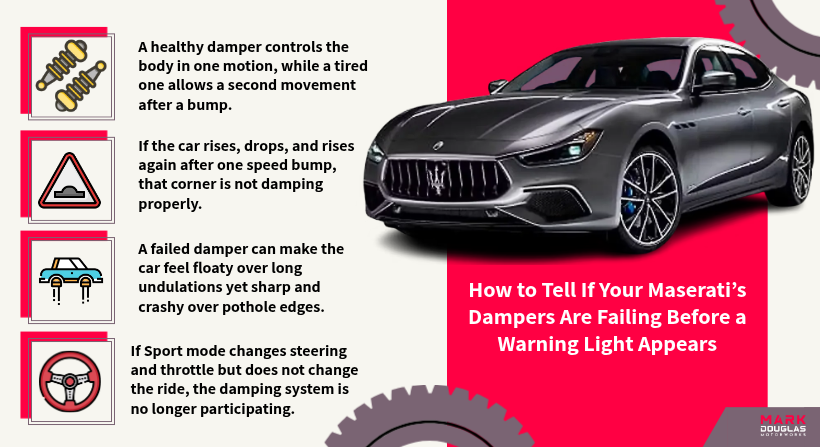
Start with the two-bump test. A healthy damper controls the body in one motion; a tired one lets it move a second time, so if the car rises, drops and rises again after a single speed bump, that corner is not damping properly.
Then look for the contradiction owners describe most: floaty over the long undulations on Marguerite Parkway, yet sharp and crashy over a pothole edge. A failed damper cannot control the slow movement or absorb the fast one, so you get both complaints at once from the same car.
The third clue is the drive mode. Press Sport, and if steering and throttle change but the ride does not, the damping side of the system is no longer participating.
A weeping damper is the failure we find most often
Get the car on a lift and the evidence is usually visible: an oily film down the damper body, a dust boot wet to the touch, or grit stuck to the shock in a way the other three corners are not. Oil on the outside means pressure has been leaving the inside.
Heat accelerates it. Damper oil thins as it works, and a summer of inland Orange County temperatures followed by hard canyon driving is a genuine workout for a seal that has already done eight or ten years. Rubber does not recover.
For reference on what the pavement is asking of it, the FHWA rates a road surface above 170 inches per mile on the International Roughness Index as poor ride quality, per ASCE’s 2025 roads assessment. Plenty of Orange County surface streets sit in that range, and your dampers absorb every inch of it.
Bad damping wears tires, and tires tell the story early
Uneven cupping across a tire’s tread is a damping problem, not a tire problem. When the wheel is allowed to bounce, the tire loads and unloads dozens of times a second, scalloping the rubber in a pattern you can feel with your palm before you can see it.
ASCE’s California report card puts nearly one-third of the state’s roads in poor condition, and Santiago Canyon and Ortega Highway are not the smooth part. On a car with worn dampers, a set of rear tires can go noisy thousands of miles early.
So we always read the tires during a ride-quality complaint. They corroborate what the owner felt, and they tell us which corner to look at first.

Replacing one corner is how owners end up replacing three
Dampers go in pairs. A new unit opposite a decade-old one leaves the axle unbalanced, the car pulls to the softer side over bumps, and you feel it more than you would expect from a single part. Front pair or rear pair, always.
Exotics are all we work on — Maserati, Ferrari, Rolls-Royce, Bentley and Aston Martin — and that focus matters on a system like this. We fit OEM parts, our master-technician experience is factory-trained on Ferrari and Maserati, and the work carries a 2-year, 24,000-mile warranty. Mission Viejo, Irvine, Laguna Niguel and Trabuco Canyon owners come to us instead of the dealer.
Frequently Asked Questions
Q: What are the symptoms of a bad Maserati Skyhook shock?
A: A floaty, wallowing ride over long bumps combined with a harsh crash over sharp ones, plus no felt change when you switch drive modes. Some cars show a suspension message, but many show nothing at all, which is why a lift inspection matters more than a scan.
Q: Can you replace a Skyhook damper with a conventional shock?
A: We do not recommend it. The module still expects to control that corner, the car loses the damping range it was engineered around, and the ride ends up worse than either setup on its own. On a Ghibli or Levante, keep the adaptive damper.
Q: How long do Maserati adaptive dampers last?
A: Age matters more than mileage. Seals and internal valving are the limiting factor, and in a hot inland climate we start finding weeping dampers on cars that are eight to ten years old regardless of how little they have been driven.
Q: Does a Maserati need calibration after suspension work?
A: The system needs the car set at correct ride height and the module verified after any damper replacement, and stored suspension faults have to be cleared and re-checked on a road test. Fitting the part is the easy half of the job.
Have the dampers checked before the canyon roads dry out
One leaking damper found now is a pair of dampers. Left through the autumn, it becomes a pair of dampers plus a set of tires and a car that never feels settled again. Bring it to Madero and we will put it on the lift.
Mark Douglas Motorworks – 23255 Madero, B109, Mission Viejo, CA 92691
Hours: Mon-Thu 7:00 AM to 6:00 PM; closed Friday, Saturday and Sunday
Website: markdouglasmotorworks.com